Modules homepage |
DIY Hi-Fi Supply Modules | Tentlabs Modules
|

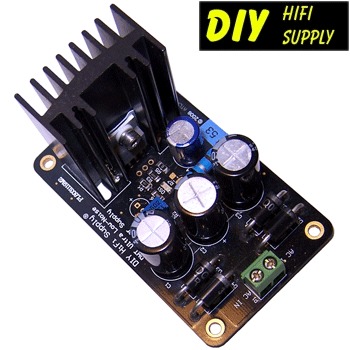
Ultra Low Noise Filament Supply 2.5-12V DC Module
|
| |
DIY Hi-Fi Supply`s very own Ultra Low Noise current source filament supply. Providing 2.5A, 2.5V-12V of pure regulated DC voltage to supply most directly heated triode valves, such as 2A3s and 300Bs. Requires an AC voltage input, typically 1 - 1.5Vs above that required for the DC output. So if you feel that your valve amp is giving out too much "Hum" them look no further.
This module offers input/output short circuit protected, overheat protected, output voltage continuously variable with on-board trimmer pot. Through-pcb vent-holes for cooling of critical parts. Also, can be mounted flat profile without heatsink by mounting regulator from the bottom and bolting regulator direct to chassis. Includes mounting standoffs and 4 pcs 0.47R resistors to trim input voltage. Function indicator LED on board. Best quality parts: Nichicon, Schottky etc.
dimension: 85mm x 50mm x 60mm (tall).
four fixing holes: 40mm x 75mm.
output ripple voltage: typically 4mv into 300B (example)
discussion & installation instructions

Price for 1 pair = £80.00 + VAT + Shipping - same price as from DIY Hi-Fi Supply
|
code: DIYFS-FILA
|
Direct Heat Triode Filament Supply Issues (as writtien by DIY Hi-Fi Supply)
|
| |
With directly heated triodes (DHT) such as the 300B and 2A3, the cathode is the filament so both heating
current and signal voltages are present. This can obviously give hum and noise issues. It is commonly thought that supplying the filament with AC voltage provides a great sound but is noisey. A DC supply is quiet but perceived as cold sounding.
What is needed?
- low noise heating current (ie low ripple and no high frequency hash)
- no intermodulation between signal and heating current
- no audio signal loss through heating current device
1. Low noise heating methods compared
- straight-in AC. Needs hum pot to reduce hum but will still always be audible on efficient speakers. Impractical for
>2.5v filaments even with hum pot. Hum pot always in the signal path and acts as shunt for signal. Filament voltage
unstable as varies with line voltage and load. Fast startup stresses power tube.
- AC to bridge rectifier to big cap. Most basic DC supply, ripple still in 250-300mv range and needs hum pot. High
frequency artifacts from solid state rectification gives nasty glare. Voltage unstable as with straight-in AC. Fast startup
stresses power tube
- AC to bridge rectifier to choke to big cap. Low ripple 80mv, suppressed high frequency hash. Voltage unstable as
stated in 2. Switch-on a little slower than in 2. Sound is good. Big choke needed and not space friendly.
- AC to bridge rectifier to regulator. Can be voltage stable give low noise of only a few millivolts. Sound depends on implementation,
needs AC voltage headroom to regulate (ie DCV out = ACV in +1 to 2v)
2. Intermodulation issues
- Any voltage fluctuations across the cathode are part of the output circuit (cathode-anode-output transformer). Audio
signal produces music at the outputs. Any fluctuation (high/low frequency) in the heating current circuit produces noise
at signal output. Such noise can modulate audio signal and create harmonics that colour (distort) the audio signal
causing subjective glare, warmth, exaggerated or diminished detail etc.
3. Audio Signal loss
- Current will always take the path of least resistance. 100% of audio signal should stay within the tube/transformer
output circuit. Caps across the filament will short a percentage of audio signal. Any path with resistance lower than the
net output circuit loop will reduce audio signal through that loop. Subjectively audio output quality suffers in every
way.
Regulated Supply
- Can be implemented as "current source" CS or "voltage source" VS or "voltage-current source" VCS (ie current source at audio
frequency and voltage source at DC)
- VS: voltage source is like a battery: low output impedance and tends to maintain voltage regardless of load, irrespective
of current. Good for stabilizing voltage, bad for intermodulation with audio signal as impedance of the device is low
- CS: current source has high output impedance and tends to maintain current regardless of load and irrespective of
voltage. Good for preventing intermodulation and loss with audio signal as output impedance is very high. Bad for
voltage stability
- VCS: voltage current source. Acts as a current source at audio frequencies but as a voltage source at DC. Benefits
include voltage stability, High impedance at audio signal frequency (audio signal sees a 'brick wall' and doesn't go
there). No shunting/shorting paths for audio signal, all signal stays within the audio output circuit. No humbucker or
caps across cathode used in this implementation - This is what the DIY Supply Filament Module does
|
|
|
 |
|