

Audio Anthology - volume 4, compiled from Audio Magazine - code 1004
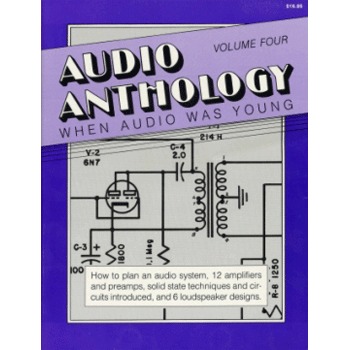
In this fourth collection of 34 articles from Audio magazine from mid-1955 through 1957, C.G. McProud takes a new tack. His emphasis in this collection is an overall view of the home sound system, offering guidance on how to plan a system, how to keep it simple and how to understand and maintain the equipment. This first section features a genuinely definitive article by the late James Moir on amplifier power requirements. Every hi-fi magazine of any note has run several articles (it seems) on this topic, but none ever treated the question with more authority than did Moir. Hardware in constructional form is still the primary focus of this collection, however. A preamp and dual-channel power amp lead off the hardware parade. An active filter between preamp and the two channel power amp allows the amp to drive two frequency ranges. A 6Y6 output amp with two channels per chassis features a patented balanced phase splitter. Since electronic crossovers were rare, this is a new departure for the time. Charles Harrison, reckoning correctly that the "treble" spectrum requires relatively little power, offers a single-ended 4-watt beauty which is flat between l00Hz and 40kHz. The stereo prospect raised the specter of having to double the size of the hi-fi system. Authors Grossman and Hellman illustrate power amps of reasonably good quality which are line operated and have low-cost output transformers. And theory of performance in output stages, damping, upgrading output transformers as well as correct tube choices all are treated authoritatively. Intel-modulation distortion is introduced, with measuring methods, and one author discusses the effects of resistor quality. Phono pickup compensation is treated as are tone controls. As tape decks began to appear, one of the best was the British Ferrograph. Arthur Wayne offered a very respectable tape amp and matching power amp for stereo tape playback. A second article provides details for a recording amp with oscilla- tors. Herman Burstein and Henry Pollak offer a comprehensive and still useful arti- cle on tape distortion.
Paul Penfield, Jr. introduced readers to the then new device, the transistor. He also offers practical tips on using the new devices and others contribute articles on solid state preamps for phono as well as magnetic tape. A simple commercial killer circuit will interest many. EJ. Jordan does a survey of loudspeaker baffles- from the flat board to the horn, while James Moir discusses the ported enclosure ten years before Thiele and Small arrive on the scene.
The volume closes with three speaker designs: a constant-width folded exponential horn, a theoretical discussion and practical design for an aperiodic enclosure and finally editor C.G. McProud's "Standard" speaker enclosure: a corner horn envelop- ing a TV system.
This fourth collection from Audio Engineering reflects the maturing of home- sound systems, the appearance of stereo and the beginnings of an evolution toward solid state. It provides a clear and authoritative picture of audio as a craft in the late 1950s.
Key Topics
- 12 amp and pre-amp circuits
- 6 loudspeaker designs
- How to plan your system
- High quality treble amp.
- Which tube should I use?
- Versatile tone control
- Ported loudspeaker cabinets
- The CW horn
- Time delay suppressor
- Dampening discussed
- A transistor VU meter
- Transistor tips
- System simplicity for audio
Book Specifications
- Paperback
- Black and white print
- 144 pages
- 218mm x 285mm
- 400g
PRICE (1 off) £15.00+p&p