

Hi-Fi Basics: Full-range or multi-way loudspeakers. What’s the difference?
Published: 24/07/2026 // Author: Jonny
“Full-range” and “multi-way” describe two different ways of sharing the audio band. A full-range loudspeaker asks one main drive unit to cover as much of it as practical. A multi-way loudspeaker divides the work between two or more units, typically a woofer and tweeter, using a crossover. Neither layout is automatically better. Each moves the engineering compromises to a different place.
What does full-range actually mean?
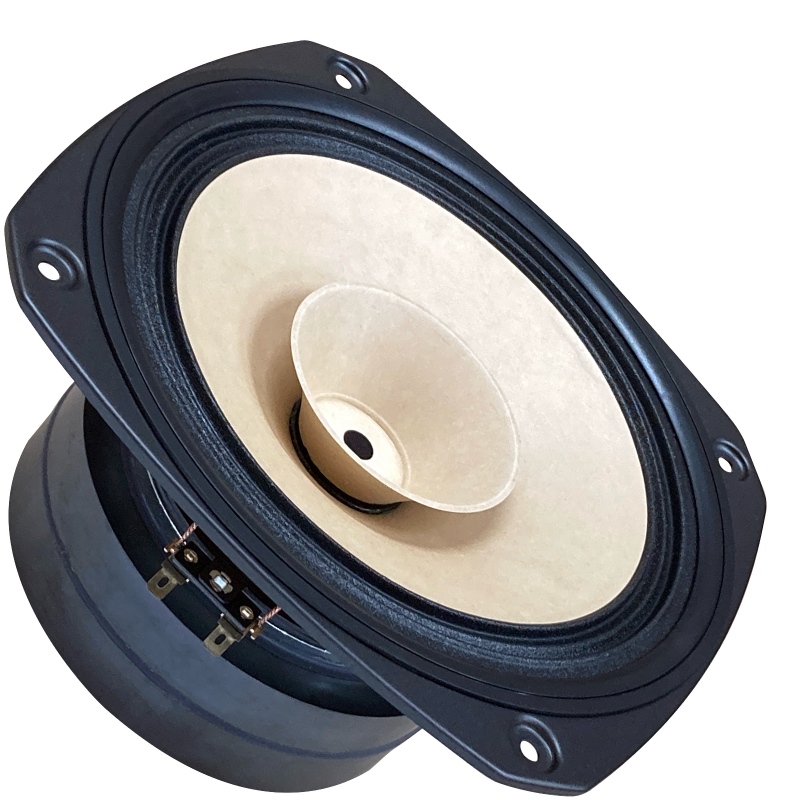
In DIY loudspeaker terms, a full-range or wide-range drive unit is designed to reproduce bass, midrange and treble from one moving assembly. It may use a specially shaped cone, a light diaphragm, a whizzer cone or a mechanically coupled centre cap to extend its useful response. Designs vary, so “full-range” is a category rather than a promise of perfectly flat output from 20 Hz to 20 kHz.
The obvious attraction is simplicity. There is no electrical crossover between separate bass and treble drivers, and voices and many instruments are reproduced by one physical source through most or all of their range. We list several approaches among our Fostex full-range drive units, from compact bass-reflex models to units intended for back-loaded horns.
“No crossover” still needs a little qualification. A single-driver design may use a correction or baffle-step network, and it may be partnered with a subwoofer or super-tweeter. The enclosure remains part of the acoustic system too. Removing a conventional crossover does not remove the need to match the driver to a suitable cabinet.
How a multi-way loudspeaker divides the work
A two-way design normally gives low and middle frequencies to a woofer or mid-woofer, and high frequencies to a tweeter. A three-way adds a dedicated midrange unit. The crossover sends the appropriate part of the signal to each driver and may also balance their levels or shape their combined response.
This division allows each unit to work over a more manageable band. A larger cone can move the air needed at low frequencies, while a small, light diaphragm can reproduce high frequencies and maintain wider dispersion. The loudspeaker drive-unit range shows the resulting variety: woofers, midrange units, dome and ribbon tweeters, as well as full-range designs.
The extra freedom brings extra design work. Driver responses overlap around the crossover region, and their output must combine in level, phase and directivity. A crossover calculated from nominal impedance alone is rarely a finished design because real drive-unit impedance and acoustic response change with frequency. Proven plans, or measurements of the actual units in the intended cabinet, are the sound starting points.
Where the compromises appear
A single cone faces a broad set of demands. Deep bass favours cone area and excursion; extended treble favours low moving mass and a small radiating area. As a radiator becomes large compared with the wavelength, its output also becomes more directional. Full-range designers address these tensions through cone profile, materials, auxiliary cones, motor design and enclosure loading, but no drive unit escapes them entirely.
A multi-way system can choose a specialist for each band, making wide bandwidth and higher output more achievable. In return, it introduces more components and the challenge of blending drivers so that the handover is well behaved on and off axis. A well-designed crossover is not simply an obstacle in the signal path; it is part of the loudspeaker’s acoustic design and also helps keep inappropriate low-frequency energy away from a tweeter.
This is why simple comparisons such as “one driver is more coherent” or “more ways must be more accurate” are not dependable buying rules. Implementation matters more than the label.
Is a coaxial driver the same thing?
Not necessarily. A coaxial unit places a high-frequency driver at the centre of a bass/mid driver, so the two sources share an axis. It may look like one drive unit from the front, but it is still a multi-way system if the high-frequency section has its own voice coil and requires a crossover. By contrast, a full-range cone may use a whizzer or centre cap driven mechanically by the same voice coil.
Which approach suits a DIY project?
A full-range project can reduce the crossover work and parts count, making it appealing for a first build or for exploring horn and transmission-line enclosures. It is not automatically the easier route: the driver’s parameters, recommended loading, listening distance and desired bass extension still have to align.
A multi-way project offers more control over bandwidth, dispersion and maximum level, but designing the crossover from scratch requires measurement and iteration. For a first attempt, a documented kit or proven design can be simpler than selecting unrelated drivers from a catalogue.
For repairs, do not treat diameter and nominal impedance as a complete match. Sensitivity, frequency response, mechanical dimensions, Thiele/Small parameters and the existing crossover all matter. The safest replacement is the specified unit or a substitute supported by the loudspeaker designer or an experienced technician.
Choose the design as a whole, not a driver count. Full-range systems concentrate their compromises in one unit and its enclosure; multi-way systems distribute them across drivers and a crossover. Both can be thoughtful, satisfying DIY routes when the parts, cabinet and intended use have been developed together.