

Hi-Fi Basics: Why does my speaker have four terminals?
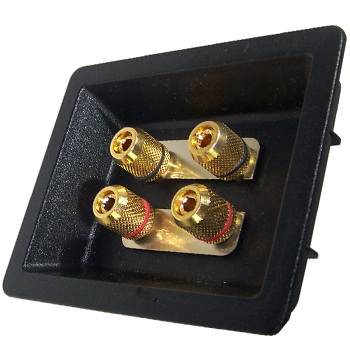
On a passive loudspeaker designed for bi-wiring, four terminals give separate access to the high- and low-frequency sections of its crossover. You can normally use one speaker cable per speaker with the supplied links in place. The extra terminals offer a connection option, not an obligation to buy more cable.
If you're used to one red and one black terminal, the second pair can look like an invitation to complicate things. It helps to understand what the small metal links are doing before deciding whether to change anything.
Two pairs, still one loudspeaker
The pairs are often marked HF and LF: high frequency and low frequency. Each has a positive and a negative terminal. These labels refer to sections of the same speaker, not left and right stereo channels.
For a conventional single-cable connection, the links join the two positive terminals together and the two negative terminals together. That lets one amplifier channel feed both sections. Follow the speaker's own connection diagram, including which pair it recommends attaching the cable to.
Our bi-wire speaker terminal cup is a useful example of the hardware. It has four gold-plated posts and comes with jumper plates for single wiring. The plates are part of the connection arrangement, rather than packaging to remove during installation.
A four-post cup alone doesn't turn a DIY speaker into a bi-wire design. The crossover and its wiring must provide the separate connections. If you're building from a kit, keep to its specified arrangement.
What changes with bi-wiring?
Bi-wiring uses separate cable paths from the same amplifier channel to the speaker's two terminal pairs, with the links removed as the manufacturer directs. The speaker's passive crossover still does its job. You're changing the cable arrangement, not adding another amplifier or converting the speaker to an active design.
Bi-amping is different: separate amplifier channels drive those sections. That needs compatible equipment and the appropriate instructions. Don't connect two amplifier outputs to linked speaker terminals. This isn't a change to improvise from a photograph of someone else's system.
Nor does a speaker amplifier's A/B switch, on its own, tell you that you have independent amplification for bi-amping. Check what those outputs actually do in the amplifier manual before planning around them.
If you're simply connecting a pair of speakers
Look for the single-wire diagram first. With the equipment switched off, check that the specified links are present, secure and joining like-polarity terminals. Keep stray strands away from neighbouring posts. Missing links are worth noticing on second-hand speakers, where a previous owner may have used a different arrangement.
If one section seems silent after connection, check the links and wiring against that diagram before assuming a drive unit has failed. Switch off again before making changes. A missing link is one possible explanation, not a diagnosis of every speaker fault.
We'd get the normal single-wire arrangement working correctly before considering alternatives. Four terminals don't promise that a different cable layout will sound better in your room. They give you a choice; the manual tells you how that choice is intended to work.