

Hi-Fi Basics: What ‘2-pole, 6-way’ means on a source selector
Published: 18/08/2026 // Author: Jonny
A 2-pole, 6-way rotary switch can select six stereo sources because it changes two separate signal paths at the same time, one for the left channel and one for the right. That is the short answer. The description says nothing about sound quality, current capacity or whether the part will fit your case, so those checks still matter.
This article is about low-level audio source selection, not mains or loudspeaker switching. Those jobs place different demands on contacts, insulation and safety. If inspection means opening mains-powered equipment, disconnect it and have stored energy safely discharged; if unsure, use a qualified technician.
“Pole” means an independently switched signal path
Inside a rotary selector, a moving contact connects a common terminal to one of several selectable contacts. One pole is one independent version of that switching action. A two-pole switch contains two paths that move together when you turn the shaft, while remaining electrically separate from each other.
That makes two poles a natural match for an ordinary unbalanced stereo source. One pole can handle the left-channel signal and the other the right-channel signal. Both reach the same numbered position at the same time, so the selected source remains a stereo pair.
It is worth keeping “two poles” separate from “two channels” in your thinking. The switch does not know what a left or right channel is. It simply has two independent contact sets. A circuit designer decides what those contacts are used for. Balanced stereo, mono switching and other arrangements can require a different number of poles, which is why the project specification should come before the shopping list.
“Way” means the available choice for each pole
Way, position and throw are closely related terms in rotary-switch listings. In a 2-pole, 6-way selector, each pole can connect its common contact to one of six selectable contacts. In this application, the knob therefore offers six source choices for each pole.
Manufacturers do not always present the wording in exactly the same order. Elma data, for example, describes functions as “poles × positions”. The practical habit is to check the table and circuit diagram rather than relying on an abbreviated title alone. Our selector-switch range includes several pole and position combinations, so the full product description is the useful part.
A simple stereo-source example
Imagine a control unit with inputs labelled CD, DAC, streamer, tuner, phono stage and spare. A 2-pole, 6-way switch has enough simultaneous choices for those six stereo sources: position one selects both channels of the CD input, position two selects both channels of the DAC, and so on.
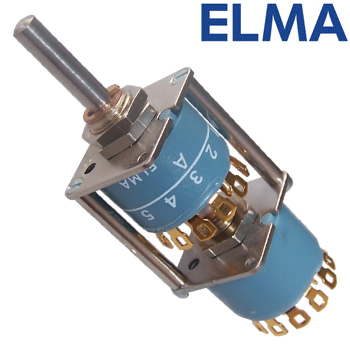
This is a functional description, not a wiring plan. Terminal layouts vary, and a rear view can reverse the apparent order compared with the front-panel numbering. Always use the drawing for the exact part number and establish which view it shows. The Elma 01-1264 2-pole, 6-way selector, for instance, has product-specific drawings and can accept a separate stop pin to limit the usable positions.
Shorting and non-shorting describe the changeover
A second label to check is shorting or non-shorting. A shorting switch is also called make-before-break: as it moves between positions, the incoming contact is made before the previous one is released, creating a brief overlap. A non-shorting switch is break-before-make: the previous contact opens before the next one closes, leaving a brief gap.
Neither label is a quality mark, and neither is automatically correct. The circuit determines whether an overlap or a gap is appropriate, so verify timing in the project documentation and manufacturer’s data. The ALPS 2 pole 6 way, shorting selector switch, in our range is shorting; the Elma 01-1264 is non-shorting. Alps now marks SRRM as not recommended for new designs, so it is a timing example rather than a recommendation.
Fitting the part
Once the electrical function is right, check the mechanical drawing. Useful dimensions include the body width and depth, the mounting-bush diameter, thread length, shaft diameter, shaft length and the space needed behind the front panel. Also check the shaft style against the knob: round, flat, splined and slotted shafts are not interchangeable descriptions.
Indexing angle affects the spacing of front-panel legends. An adjustable stop can be useful when a switch offers more positions than the current project needs, but confirm that the stop arrangement belongs to that exact switch family. Terminal style and orientation also affect access inside a compact case. A photograph helps with recognition; a dimensioned drawing decides fit.
Finally, read the electrical ratings and formal specification instead of assuming that all visually similar selectors are equivalent. Our selector-switch category is a convenient starting point, but the linked product data should settle the details.
Conclusion
For a conventional unbalanced stereo selector, “2-pole, 6-way” usually means two channels can move together across six source positions. Treat that as the beginning of the specification. Changeover timing, physical dimensions, terminal layout and the manufacturer’s drawing are what turn a plausible description into the right part.